Dog Nose Hyperkeratosis: Causes and Care
Nasal hyperkeratosis makes a dog's nose hard, dry and crusty. A plain-English guide to the causes, a gentle soak-and-balm routine, and when to see a vet.
Quick answer
Nasal hyperkeratosis is a build-up of excess keratin that leaves the tip of a dog's nose hard, dry and crusted, sometimes with a cauliflower-like frond of extra tissue. It is usually not painful and cannot be cured, but a gentle soak-and-balm routine keeps it soft. Sudden crusting, ulcers or bleeding need a vet.
If the smooth, leathery tip of your dog’s nose has turned hard, dry and crusty, maybe with a rough, almost cauliflower-like ridge building up on top, you’re very likely looking at nasal hyperkeratosis. It looks alarming, but for most dogs it’s a manageable, long-term quirk of the skin rather than an emergency.
This guide is the nose-specific companion to our broader hyperkeratosis in dogs guide, which covers the paw pads too. Here we’re focused entirely on the nasal planum, the “nose leather”, why it hardens and crusts, how to care for it gently at home, and the warning signs that mean it’s time to see your vet.
Key takeaways
- Nasal hyperkeratosis is excess keratin building up on the nose leather, leaving it hard, dry, crusted, sometimes with frond-like growth. It usually looks worse than it feels.
- The breed-linked and age-related forms are managed, not cured, a gentle warm soak plus a dog-safe balm keeps the nose soft and comfortable.
- Get a vet diagnosis first, sudden crusting, ulcers, bleeding or loss of colour can point to something more serious that needs treating.
What nasal hyperkeratosis actually is
Keratin is the tough protein that forms the outer layer of your dog’s skin, the same stuff as their claws and our fingernails. Normally the body sheds old keratin at a steady rate. With hyperkeratosis, it’s made faster than it’s shed, so it piles up on the surface as a thick, hard, crusty layer.
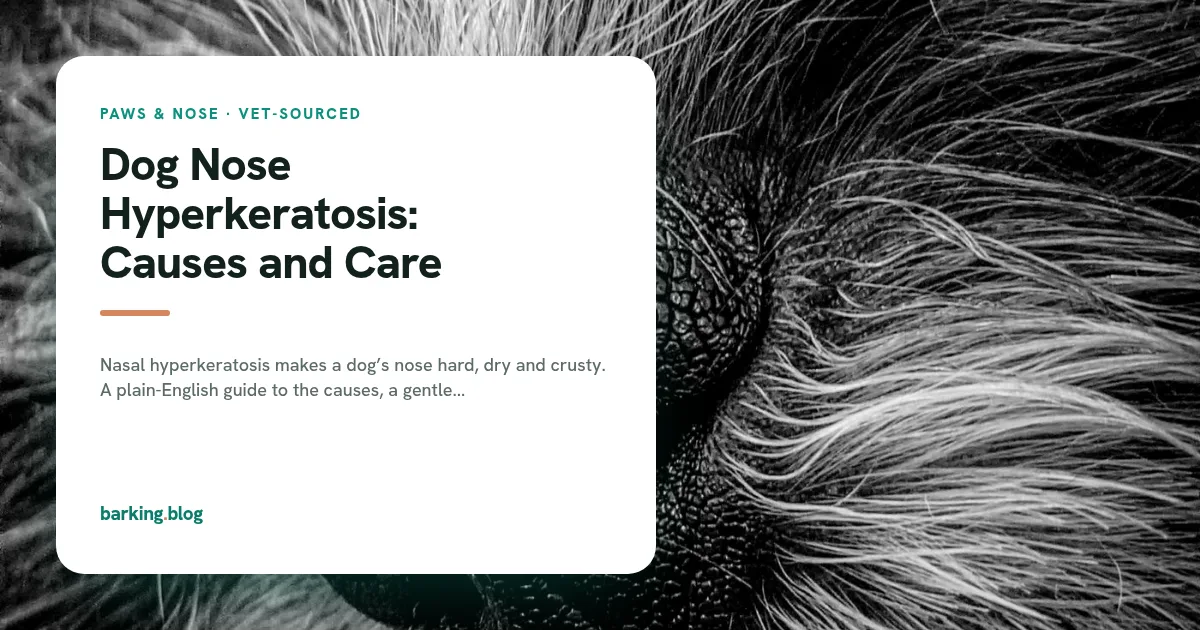
On the nose, the MSD/Merck Veterinary Manual describes this as “fronding extensions of the dorsal aspect of the nasal planum”, in plain English, rough, hardened ridges building up across the top of the nose. It usually isn’t painful and there’s no redness or inflammation with the everyday form.
This is very different from a simple dry nose, which comes and goes with sleep, weather and age and needs nothing more than a little moisture. If your dog’s nose is only mildly dry rather than genuinely thickened and crusted, our guide to why a dog’s nose gets dry is the better starting point. Hyperkeratosis is a step beyond that: a persistent, hardened build-up you can feel as a rough, raised texture.
What it looks like on the nose
Nasal hyperkeratosis tends to creep in gradually, so it’s easy to miss at first. The things owners usually notice:
- A hard, dry, crusty surface where the nose used to be soft and smooth
- Rough, frond-like or cauliflower-like ridges of extra tissue building up on top
- A dull, thickened look rather than the usual healthy sheen
- Flaking or peeling at the edges of the crust
- Cracks or fissures in more advanced cases, and if these get deep, they can split and bleed
In its mild, everyday form it’s mostly a cosmetic thing. The reason to stay on top of it is that a thick, brittle crust can eventually crack, and a deep crack that reaches living tissue is sore and can let infection in. If the crusting is heavy or has a particular pattern to it, it’s also worth reading our companion piece on the crusty dog nose, which walks through what different kinds of crusting can mean.
What causes it, and why a vet check matters
Most cases fall into the “just how this dog is” category, idiopathic (no identifiable trigger) or breed-linked. But a hardened, crusty nose can also be a symptom of something that needs treating, which is exactly why the safest first step is a proper diagnosis rather than guessing at home.
| Cause | Typical signs | Approach |
|---|---|---|
| Idiopathic / age-related | Gradual crusting in an older dog; nose otherwise healthy, no pain or redness. The MSD Manual notes it "occurs in older adult dogs" and often needs no treatment. | Managed at home with regular softening and balm; vet confirms nothing else is going on. |
| Breed / hereditary | Bulldogs, French bulldogs, boxers, pugs, cocker spaniels, Dogues de Bordeaux. Labradors can carry a hereditary form that appears young rather than in old age. | Lifelong management; earlier onset is worth a vet's confirmation. |
| Distemper legacy ("hard pad") | Thickened, hardened nose and paw pads in a dog that had distemper. Now rare in the UK thanks to vaccination (PDSA). | Vet diagnosis; supportive care. Keep vaccinations up to date to prevent it. |
| Leishmaniasis | Crusting with ulceration or bleeding of the nose. Uncommon in the UK, mainly linked to travel abroad. | Needs veterinary diagnosis and treatment, not a home-care case. |
| Autoimmune disease | Conditions such as pemphigus foliaceus or lupus, often crusting plus ulcers, redness, sores or loss of pigment on the nose. | Requires a vet: tests and prescription treatment for the underlying disease. |
There’s a nutritional angle too: a zinc deficiency or malabsorption can cause skin thickening and crusting in some dogs. The takeaway across all of these is the same, the everyday breed-linked and age-related forms are yours to manage at home, but the “symptom of something else” causes need a vet to diagnose. When in doubt, have it checked before you start treating it.
The at-home care routine
For the ordinary breed-linked or age-related kind, home care is simple and it’s the same idea every time: soften, then moisturise. Vet-reviewed sources like PetMD and Wisdom Panel describe management as keeping the nose well moisturised with topical rinses, ointments and balms, no harsh scrubbing, no picking.
- Soften the crust first Hold a warm, damp cloth or compress gently against the nose for a minute or two, or wipe it over with warm water. This softens the hardened keratin so nothing has to be forced.
- Wipe away only what lifts freely Once softened, gently wipe off the loose flakes that come away on their own. Never pick, peel or pull at crust that's still attached, it's fused to living tissue and will tear.
- Apply a dog-safe balm Smooth on plain unrefined coconut oil or a dog-specific nose or paw balm. Because your dog will lick their nose, only ever use something safe to swallow. That rules out human hand creams, essential oils and zinc-oxide creams, which can all be toxic to a dog that licks them.
- Make it a habit Apply daily while you're getting the nose soft, then ease back to a few times a week for upkeep. Just before a nap is ideal, so the balm soaks in before your dog licks it away.
- Add a little humidity Dry, centrally heated air makes crusting worse. A humidifier in the rooms your dog uses most helps keep the nose from drying out again.
What your vet can offer
If home care isn’t keeping on top of it, or your vet suspects one of the underlying causes, there’s more they can do. They can confirm the diagnosis, ruling out the autoimmune, infectious and nutritional causes above, and may prescribe stronger keratolytic ointments that break down excess keratin more effectively than a balm alone. If a crack has become infected, they can treat that; if there’s an underlying disease, treating it is what improves the nose. For the hereditary and idiopathic forms, though, the honest picture is that it’s controlled rather than cured, and a steady home routine is the mainstay.
When to see your vet
See a vet if
- The crusting came on suddenly, or is getting noticeably worse.
- There are ulcers, open sores, or cracks that bleed or ooze.
- The nose is losing its colour or pigment, or the crusting spreads to the lips, eyes or elsewhere on the face.
- Your dog is young, or you also see lethargy, weight loss or skin changes elsewhere, these can point to an underlying condition.
- Home care hasn't helped after a couple of weeks, or your dog is pawing at or bothered by the nose.
None of these mean the worst, but each is a sign the crusting might be more than the everyday breed-linked kind, and those are exactly the cases where an early diagnosis makes treatment simpler. A hard, crusty nose that’s otherwise not bothering your dog is rarely urgent; paired with ulcers, bleeding or a change in your dog’s general health, it’s worth a prompt call.
For most dogs, though, nasal hyperkeratosis is a bit like caring for very dry skin: not something you fix once, but something you keep comfortable with a little regular attention. Soften, moisturise, keep an eye on it, and let your vet handle anything that looks like more.
Sourced to
Is nasal hyperkeratosis in dogs painful?
On its own, no, the excess keratin itself is not painful and there is usually no inflammation. It becomes uncomfortable only if the thickened, brittle surface splits into deep cracks that reach the living tissue underneath, which can sting and bleed. Keeping the nose soft with a balm is what prevents it getting to that stage.
Can you cure hyperkeratosis on a dog's nose?
The common breed-linked and idiopathic forms cannot be cured, they are managed for life with a simple moisturising routine, much like caring for very dry skin. If the crusting is a symptom of another condition, such as an autoimmune disease or a nutritional problem, treating that underlying cause can improve the nose.
Can I put coconut oil or Vaseline on my dog's nose?
Plain, unrefined coconut oil or a dog-specific nose or paw balm are safe choices, because dogs lick their noses and will swallow whatever you apply. A tiny amount of petroleum jelly is generally tolerated, but avoid human hand creams, lip balms, essential oils and any nappy or sunblock cream containing zinc oxide, which is toxic to dogs if licked off.
Which breeds get nasal hyperkeratosis?
It is seen most in bulldogs, French bulldogs, boxers, pugs, Labradors, cocker spaniels and Dogues de Bordeaux, though any dog can develop it, especially with age. Labradors in particular can carry a hereditary form that shows up in puppyhood rather than old age.
Should I peel the crust off my dog's nose?
No. The hardened crust is fused to living tissue, so picking, peeling or pulling it off tears the skin and causes pain and bleeding. Soften it first with a warm, damp compress and only wipe away the flakes that lift away freely on their own. Never force it.
The Barking newsletter
Get calmer, vet-sourced advice.
One friendly email when we publish something worth your dog’s while. No spam, no scares.